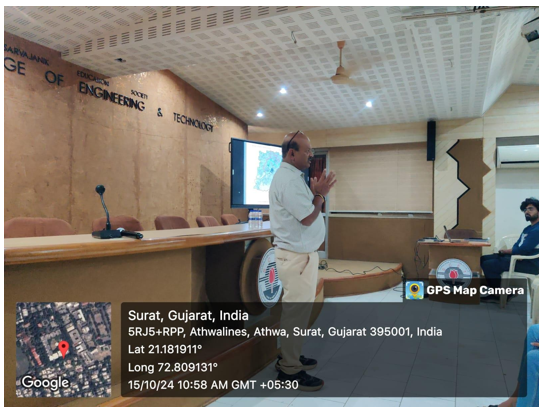
Description
https://idpt-scet.ac.in/upload/Expert%20Lecture/Report%20on%20Expert%20Lecture%20on%20Regional%20Planning%20in%20India%20-%20A%20Brief%20Scenario.pdf
Expert Lecture on “Regional Planning in India: A Brief Scenario”
Date: 15th October, 2024
Time: 9:00 am – 12:00 pm
Venue: N J Seminar Hall, SCET Admin Building, Sarvajanik University
Event Coordinator: Prof. Kuldeepsinh Jadeja, Assistant Professor, IDPT
Organized by: School of Planning, IDPT, Sarvajanik University
Target Students: All Students of M.Plan. – 1st Year & 2nd Year
Total Attendees: 53
|
No. of Students
|
No. of Faculties
|
Other Invitees
|
Total
|
|
48
|
5
|
0
|
53
|
Overview:
Regional planning in India is a vital tool for sustainable development, addressing imbalances in socio-economic development and ensuring equitable resource distribution across different regions. This concept has been integral to India's postindependence planning efforts, driven by the need to address regional disparities in terms of infrastructure, employment opportunities, and the standard of living. On 15th October, 2024, an expert lecture on "Regional Planning in India" was conducted, focusing on the strategies, challenges, and future directions of regional planning in the country. The event brought together experts, faculty member and students to discuss the importance of regional planning in achieving balanced development and addressing socio-economic disparities across different parts of India. The lecture was part of an ongoing knowledge enriching series aimed at exploring sustainable development initiatives in the Indian context.
The Lecture was conducted in 2 sessions
Session 1 – Regional Planning in India – Special Focus on Surat Region.
Session 2 – Transportation Planning – Special Focus on Surat Sitilink Project
The lecture was well-received by the Students, sparking thoughtful discussions on the future of regional planning in India. Students left with a deeper understanding of the complexities of regional development and a renewed commitment to fostering balanced growth across the country.
Speaker Details:
The Session was conducted by an eminent speaker Dr. Debasis Basak.
Dr.Debasish Basak is Engineer – Planner. He done BE Civil from SVR (SVNIT Surat), M.Plan. (Urban Planning) from SPA Delhi and Ph.D. from SVNIT Surat. His Research focused on Development of Methodology for assessment of quality of urban life in context of metropolitan city in India.
Dr. Basak has been serving Surat Municipal Corporation (SMC) since last 35 years. He started as on capacity of Assistant Engineer in Central Design Department of SMC in 1988 and then promoted as deputy town planner in 1999, Executive Engineer in 2003 and lastly general manager of Surat Sitilink Project from 2017 to 2024. He is now started and directing a firm “Urban Eco Initiatives Pvt. Ltd.” In Surat which is primarily engaged in sustainable & innovative planning Solutions aimed at enhancing the quality of urban life.
Outline of Session
9: - 9:10 AM – Welcome Address & Introduction to Speaker and Topic 9:00 to 10:30 AM – Regional Planning in India, Special Focus on Surat Region.
10:30 – 11:50 AM – Transportation Planning, Special Focus on Surat Sitilink Project. 11:50 – 12 PM – Vote of Thanks
Key Topics Covered:
Session 1 – Regional Planning in India – Special Focus on Surat Region.
- Definition and Importance of Regional Planning
- Historical Overview of Regional Planning in India
- Current Regional Disparities
- Policy Initiatives and Government Programs
- Challenges in Regional Planning
- Overview of Regional Plan Scale in South Gujarat & Surat
- Planning & Preparation of Surat DP 2035
Session 2 – Transportation Planning – Special Focus on Surat Sitilink Project
- Overview on Transportation Planning in India
- Types of Transport Modes
- Overview of Public Transportation
- Surat Sitilink Project: Brief Overview
Outcome:
Regional planning in India remains a crucial instrument for addressing the complex challenges of regional disparities and achieving sustainable development. With a combination of forward-thinking policies, technological advancements, and a focus on social equity, India can foster balanced regional growth and promote an inclusive development model that benefits all regions equally.
This lecture presents an overview of the evolution, challenges, and future directions of regional planning in India, highlighting the importance of an integrated and sustainable approach to regional development.